How should vendors and customers think about vendor pricing when it comes to pricing? Is vendor behavior driven by greed? To an extent. Is vendor behavior driven by fear (of litigation, bad press, or other horrors)? To an extent. Is vendor behavior driven by altruistic concern over what it will take to make a customer successful? To an extent. Is vendor behavior driven by customer behavior? 100 per cent.
All of which is to say, vendors behave the way vendors do, because customers drive them to do so. Vendors want customers' money now, and in the future, and they will do what they have to do to get customers to hand over money to them. Vendors want what they consider to be their fair compensation for the intellectual property (IP) they offer, and the work they do on behalf of the customer.
Still, many customers feel that they are being "taken advantage of" by vendors. From a vendor perspective, this is hard to understand. After all, if you don't like the product or its associated services, then as a buyer you can switch to a different vendor/supplier. If there is no alternative, or the switching costs are high, then why should the vendor lower its price? Customers are able to hire experts (like the aforementioned Ray, Mike, Dennis, and Vinnie) to learn from the experiences of other customers. Customers are able to network, demand references from vendors, and read industry news and analysis to understand what they're getting into. And no customer should make a major purchase without undertaking such efforts.
How products and services are priced
Over the years, I developed a theory of pricing that is based on economics and psychology (but let's be realistic, economics is macro-psychology -- the psychology in aggregate of some group of people). My theory goes like this: the maximum price (Pmax) a vendor can get a customer to pay is equal to some fraction (b) of the customer's benefit from the product or service (B), multiplied by the customer's perception of the probability that the customer can achieve that benefit (s), multiplied by the perceived competitive differentiation of the offering (d). Written symbolically:
Pmax = bsdB
Put into words another way: a customer is willing to share some portion of its benefits with the vendor who made those benefits possible. The amount the customer is willing to share is based on how much the customer thinks is fair to share, how likely it is that the project will be successful, how many competitors or substitutes are there out there, and the total benefit expected. Prices will go down if the customer doesn't treat a vendor as a partner, expects that the project is risky, believes that there are many alternatives (competitors, or entirely different ways of spending budget to achieve shareholder value), or doesn't expect to achieve a lot of benefit from the project. Conversely, the price will go up if the customer views the vendor as a partner, believes the project will be successful, understands that there is a meaningful and valuable difference between the vendor's offering and any other market alternative, and has reason to believe that a significant benefit will accrue to the customer as a result of the vendor's offering.
The factors
b, the customer's willingness to share their benefits with the vendor, ranges from 0 to 1; 1 means the customer believes it is fair to give all its benefits to the vendor. Most commonly this number would be far less than 1 (no customer will participate in a transaction where they expect to gain nothing!). The "Ultimatum Game" experiment shows that psychology overcomes logic when dividing up benefits, but - in the real world - business sense generally prevails. Customers are willing to share some portion of the benefits with vendors who bring them solutions; in my experience, this factor is generally between 0.25 and 0.5, depending on the urgency behind solving the customer's problem.
s, the customer's perception of the probability of the project's success in achieving the customer's desired benefits, ranges also from 0 to 1; 1 means the project is guaranteed to achieved the desired benefits. Most commonly, for IT projects, the probability of success should never be estimated above 0.5; however, this factor is the customer's perception that the project will succeed. This factor can be artificially lowered or raised by the actions of the customer and the vendor. For example, a start-up will generally be considered a riskier partner; when offering the same product, this factor will be about 3 times lower for a start-up acting alone, as compared to the same exact product when sold by or bundled in by a large, established vendor. Vendors can increase "s" by providing evaluation access (as in product-led sales approaches), demonstrations, customized demonstrations, case studies, responses to objections ("objection handling"), customer testimonials and reference calls, user group meetings (with happy users!), transparency about uptime (e.g. as Salesforce.com does), by offering various services to ensure project success or solution completeness, by creating a fixed-price bid, and in many other ways.
d, the customer's perception of the competitive differentiation of the product offering, also ranges from 0 to 1; 1 means there is no substitute for the offering. Now, there is always a substitute for any offering - the "do nothing" option (and often the "build it ourselves" option) - in corporations, this might also be considered to be the "do something else with the same budget" option. Although "d" is hard to quantify, it sometimes seems to be as simple as the reciprocal of the number of direct competitors (including "do nothing") - when there are two competitors, "d" might be 1/3 (two competitors plus "do nothing" = 3) or 1/4 (two competitors, do nothing, and built it ourselves). Vendors can increase the perceived competitive differentiation in many ways. Vendors can offer a different business model (e.g. prepaid phones, freemium model, subscription pricing, open source, guarantees), complementary services (e.g. 24x7 monitoring, backstop service to ensure your SI is following best practices, annual user conferences, dedicated advisor, active user community, customer testimonials), or differentiated features (e.g. better UI, high availability, faster performance). However, no matter how the product is differentiated, none of that matters unless the customer sees the product as differentiated! The better UI must be demonstrated, certified by some authority (another customer, an analyst, an award of some type), and included in the evaluation checklist by the customer, or the vendor will be unable to increase "d" and thus capture a higher maximum price.
B, the customer's expected benefit, is a financial measure of the customer's net benefit (total benefits converted to currency, minus total costs converted to currency). How much would it be worth to the customer to have that benefit? Vendors, by virtue of working with many customers and speaking to many experts, often know of benefits the customer may not. Vendors and customers work together to identify "B," generally through some ROI study. Vendors can influence "B" by creating a good process for capturing benefits customers expect across various industries, geographies, and enterprise sizes, and then sharing these benefits with customers (and trying to get them onto evaluation checklists). Testimonials, expert estimates, studies, and other validating techniques help a vendor to establish the highest possible "B" with the customer. "B" is a "net benefit" figure, so any costs associated with the offering will reduce "B" - these can be switching costs, the cost of the evaluation process undertaken with the purchase, long-term costs, and implementation ("go live") costs.
All this, b times s times d times B, yields the maximum price the customer is willing to pay for the offering, or Pmax (pretend the "max" part is a subscript). Vendors may choose to settle for a lower P.
Example application of this theory
This pricing model is just a model, or a theory. Let's apply it to an example case (or two) to see if it makes sense in a real-world context.
Let's consider a company who would like to implement a new customer service system, such as a customer community system. This system might offer benefits to the company including better customer satisfaction due to faster problem resolution, cost avoidance due to fewer calls to the contact center, cost avoidance due to creation of a better knowledge base for problem resolution, increased revenue due to upsell and cross-sell opportunities, and perhaps other benefits. In aggregate, the company expects to achieve $5 million in additional revenue annually at a cost of $2.5 million, and a one-time implementation cost of $500K - so B = $5M - $2.5M - $0.5M = $2M. This customer tends to treat vendors somewhat as partners, so b is 0.3. The customer believes that the system has an 80% probability of achieving desired goals, given that it is a SaaS system with little technical risk, and given that many other companies are successful with this supplier, so s = 0.8. Finally, the company has identified 3 vendors in total who have such systems, and the ability to build a system on their own, so d = 1 / (3 competitors + roll our own + do nothing) = 0.2. In this example, Pmax = (b = 0.3) * (s = 0.8) * (d = 0.2) * (B = $2M) = $96,000/year for a one-year subscription price. Fair enough, seems like a very reasonable price. Assuming these figures stay the same, over a three year period the maximum price per year would be higher, given the implementation cost is a one-time investment (Pmax = 0.3 * 0.8 * 0.2 * $7.5M = $360K, or $120K per year).
What happens if the customer wants additional modules? Let's say the customer is looking at a new "generative AI" module, which is only available from the original vendor. If the benefits of this module are $2.5 million in savings due to reduced contact center costs at a one-time implementation cost of $100K, better customer satisfaction, etc., what is Pmax? Well, b is still 0.3. s is probably very high, since the major implementation is completed - maybe 0.9. The number of competitors is 0, since no alternative exists that works with the vendor's customer community system, so d = 0.5. Pmax is now $324,000, for the same $2.5 million benefit. So the community system is worth $120K per year according to this model, but the AI system (with the same expected annual benefit) is worth $324K.
Industry analysts may now tell the customer that the vendor is ripping them off due to "vendor lock-in" and "switching costs," but nothing could be further from the truth. Risk and competition for the second deal are now lower, so the price should be higher! Both sides are acting in their own interest, and neither is being cheated.
In fact, many customers try to include a "standard discount" in their negotiations, just so they can avoid paying this kind of fair price later for their benefits. Vendors respond to this as expected, by creating new products (instead of adding features), or by reselling third party products, or by jacking up prices. In this case, instead of trying to create win-win scenarios, the vendor and customer are locked in a "zero-sum game" (at best), and everyone loses out on the possibility of synergistic wins.
Industry observers, and customers as well, should remember this: any vendor who strives to raise Pmax will be working in the customer's interest - by reducing risk, creating differentiated solutions, and adding new benefits to their solutions. Obviously, some vendors also work to reduce the number of competitors to raise Pmax, but that is why we have anti-trust laws and occasional enforcement.
Customers should want to be good partners for their vendors. Customers should also strive to raise the value of their projects (Pmax), in a sense - they should also be striving to remove risk from projects and to increase the benefits obtainable. However, customers should also act in their own interest, by being aware of all relevant competitors, not introducing risk into a project, not overestimating probability of success, thinking into the future thus hedging risk and growth, and not expecting unrealistically high benefits from projects.
Any thoughts on this? Any good examples you'd like to share?
 One item is based on a significant difference between how vendors view license fees for marginal users, versus customers viewing those fees (years after the contract is written) based on average price. Let's eavesdrop on a typical enterprise software sale to see the roots of this later dispute.
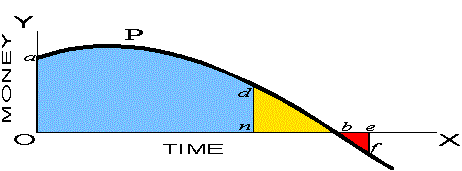 To the sales rep, the marginal utility of a deal in the future, when he may not have this account any more, is close to zero, so he would like to pull the largest check possible into this quarter, regardless of the interest of the vendor. The vendor's interest is enforced by a contracts and discount policies process, ensuring that the sales rep doesn't give away the farm, and that the customer gets a reasonable discount for taking on the risk of acquiring additional licenses.


